11.23.2013

13I: Off to Office Hours

With my first college finals impending, I need to start preparing so that I can get good grades. This realization led me to my history professor's office earlier this week with a few questions for him.

 
This past Wednesday, I visited Dr. Troy Rondinone's office hours in EN C211B at 12:00pm. His tests are some of the hardest exams I have ever had to take. He gives us so much information every class that it is difficult to guess what we will be tested on. This class is a lecture, so I am just furiously writing down that he is saying because there are never any notes written on the board to copy down. Also, my test scores in the course have been decreasing lately, and I feel as though I need to gain as much information about the final as possible in order to get a better over-all grade in that class.
 
The first question I asked him was, "Is the final going to be cumulative?"
He informed me that it will be, but he will provide us with a study guide so that we can narrow down the topics which we have to study.
 
The second question that I asked was, "What will the format of the final be?"
He said that it will be entirely multiple choice and matching like our other tests so far this year. He told me that the only difference between the final and our previous exams is that it will be longer and have questions on each section we have studied so far.
 
After speaking to Dr. Rondinone I feel less anxious about our final. The fact that it will be very similar to the other exams I have taken in that class makes me feel more at ease. I feel better prepared for the final exam now that I have spoken to him.
 
 
Contact information:
Troy Rondinone, Ph.D.
Office: EN C211B
Office hours: Mon 12-2; Weds 11-1 pm; Thurs 12-1pm   
Office phone: 203-390-8836


13B: The Creative Side

No one wants to watch a boring video. Creativity is a necessary component of my video project. I plan scripting out my video in a way that is funny and engaging.

 
My Inquiry professor is going to have to watch about 40 final project videos, so if they are not interesting, she will be extremely bored. I, personally, will not even watch a video online unless it seems funny and attention-grabbing. No one wants to read a list of facts on a topic; we want to be entertained and inspired to learn more.
 
What I plan on doing in order to make my video blog interesting is creating a humorous skit. I will play up the comically true stereotype of the overly-stressed college student. I find that comical over-acting is always funny. When you take a simple issue and show it in its most extreme form, it is more entertaining. For example, poor diet is something most college students encounter for many reasons, but watching someone stuff their face with junk food like an animal is an extreme and comical representation of this issue.
 
 
I wanted to make my video like an infomercial. It begins with me catching the attention of a college student and asking them if they are stressed. I then continue on to tell them that it does not have to be that way and that I will show them how to manage and alleviate their stress. Then, I have them act out all of the different symptoms of stress (like I mentioned above with the example of a poor diet).
 
I believe that I am taking a creative perspective of this topic as opposed to simply reciting facts and statistics at the audience. My video will be relatable, funny, and entertaining as well as informative and (hopefully) helpful to some of my peers who are feeling just as stressed as I am.


13A: Brace Yourselves, Finals Are Coming.

My midterm video project was kind of a flop, so this time around I plan on making my final video blog truly representative of the great work I am capable of.


In order to receive a noteworthy grade on this project, I have to demonstrate college-level thinking. I plan on incorporating this into my video by splitting it into four different parts: factors that typically cause college students stress, the signs that you may be over-stressed, how to manage/alleviate your stress, and the health risks that people who do not manage their stress tend to face.

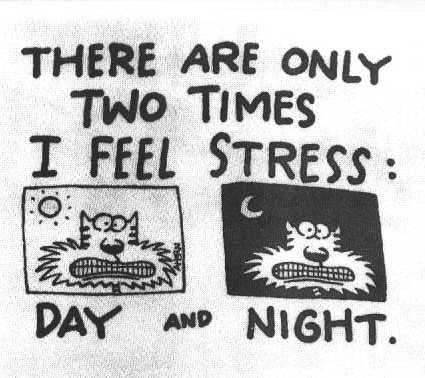
Stress Picture
 
I wanted to do something more than simply listing facts about stress. I wanted to make it relatable to the college students who will be watching this video. I will have visual representations of each situation for viewers to see. A friend of mine volunteered to act out all of the stressful experiences that people in college encounter every day. I feel that this tactic will make my video extremely understandable. Also, the cause and effect aspect of it will make it very easy for viewers to see that they do the same things every day that are causing them to be stressed. My video will show them both outcomes depending on whether they attempt to handle their stress now or let it get the best of them in the long run.
 
By showing the pattern of events that occur in a college student's life that can either positively or negatively affect them later on, I feel that I am demonstrating higher-level thinking. I am trying to show my peers that if they can get their stressors under control now with exercise, eating right, etc., they will be healthier in the future. If they cannot manage their stress today, it can lead to many health risks and depression later on. I want everyone to know what resources they have available to them on campus as well so that they can have happier lives with less stress.


11.16.2013

12V: A Unique Perspective

Interdisciplinary Perspective: What it is and how affects the lives of college students like me.


Interdisciplinary perspective is the combination or involvement of two or more academic disciplines or fields of study. This idea encompasses the main theme of my Inquiry class this week: Liberal arts. Students need an interdisciplinary perspective to provide them with the broad perspective required for being prepared for the ever-changing nature of working life. Liberal education programs provide just that. They require that you take information from all different disciples as the foundation of your education before focusing on a specific career.


Two other words that were themes in some of my other classes this week werecriminology and matrices.
Criminology is the study of crime and criminals. This is the topic of my Sociology class right now.
A matrix is something that constitutes the place or point from which something else originates, takes form, or develops. (Matrices is the plural form of matrix.) In my geography class, this week we had to work on charts that he called matrices which posed a hypothetical situation about which city in Texas would be the most financially beneficial to build a factory that produces belts. We had to determine which place would be the most cost-effective for the development of the belts before they are shipped to the target market area.

 
All of my classes tend to have specific themes every week. It is important to understand the key terms and ideas every week in class to so that you do not fall behind. If you are ever unsure about the current subject, you have to go speak to your professor during his or her office hours. Being up to pace on learning new vocabulary is the best way to make sure you fully understand any topic.

12I: Its Peanut Butter Jelly Time

This week I experienced the wonder that is Peanut Butter and Jelly Thursday in Engleman!

 
Every Thursday across from the Bagel Wagon in Engleman from 11am-2pm you can make yourself a sandwich for FREE!
 
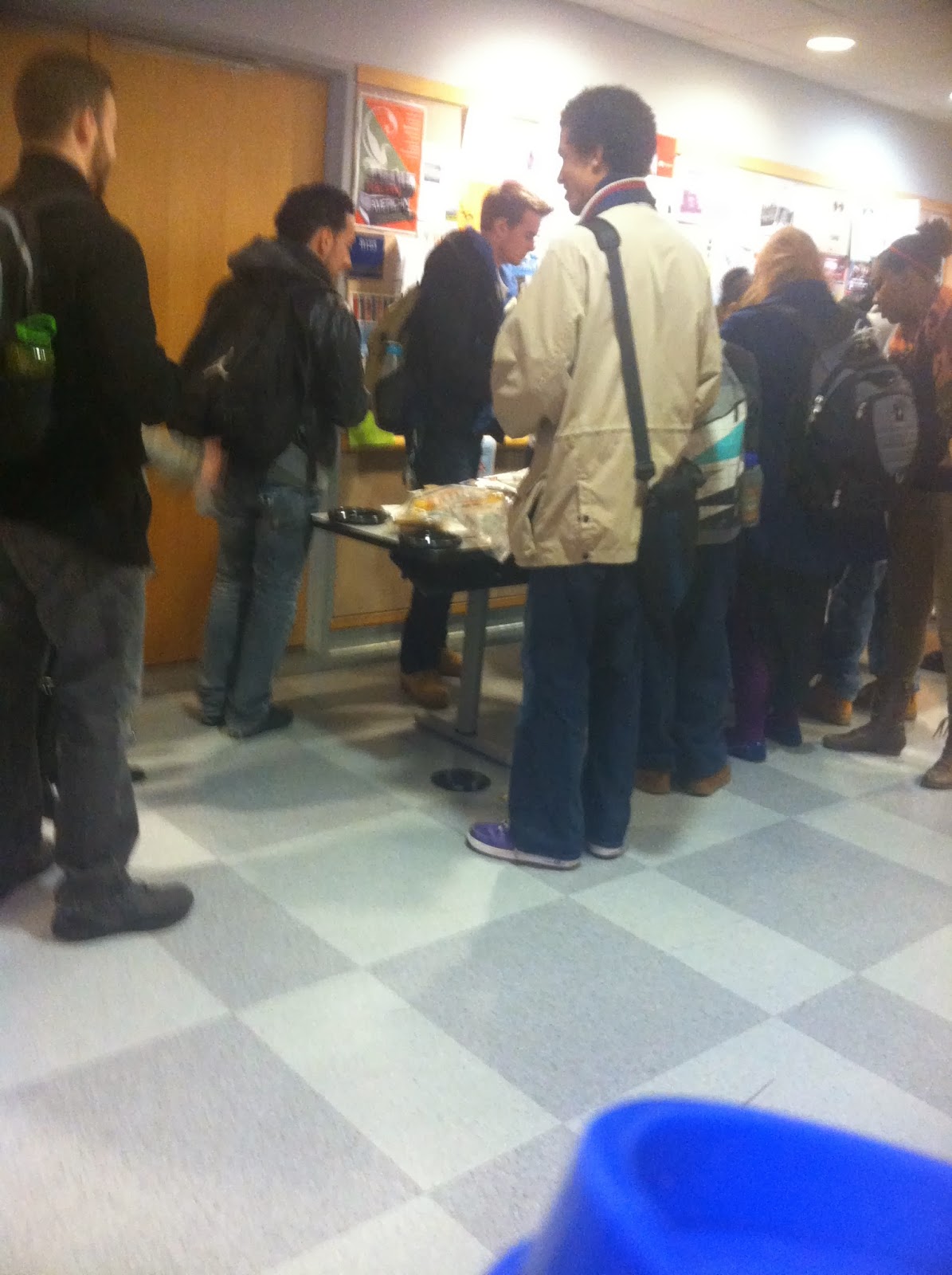
I had heard of PB&J Thursday, but until this week when I stupidly left my lunch in the fridge at home, I had never felt the need to try it out. Conveniently, this was the best day of the week to forget a lunch because I was able to hop in line and make my own sandwich for no cost at all. (Below is my blurry picture of the line/table where the food was displayed for everyone to take.)


The line began pretty far down the hallway, but it moved fairly quickly. There was white and wheat bread, peanut butter, grape and strawberry jelly, and even Nutella provided! I made myself a peanut butter and Nutella sandwich on white bread and grabbed a Capri Sun (also free) on my way out. PB&J Thursday is such a great idea. I wish I knew what group sponsors it, but whoever it is does a great thing for a lot people every week.


12B: The Liberal Edge

After reading a few articles regarding liberal education programs, I was asked to pose an inquiry question about the subject. The following is a question that I have thought about in the past and that I am sure others have pondered as well:

Is it more beneficial to spend more time in school gaining a liberal arts education or to immediately focus on your career and begin working sooner?


I believe that it is more beneficial for a student to attend a liberal arts university as opposed to training specifically for his or her future career right out of high school.
(As I mentioned in another blog this week...) Liberal education programs provide students with skills to think critically and problem solve. These traits cannot be learned in a technical/professional school which focuses solely on educating you for a career or job. Liberal arts universities strive to mold people into well-rounded individuals with a vast knowledge of the world. Rebecca Chopp, President of Swarthmore College (a top liberal arts college in the U.S.), said in an interview that, “Liberal arts is founded on a whole person, developing a person athletically and academically...The 21st century is one of entrepreneurship and innovation. There will not be fixed careers. The liberal arts teaches you to think outside the box.” I agree with her in the fact that current jobs are focused on innovation. It is a lot harder to find high-level jobs today than it was years ago because the standard for those kinds of jobs are so high now. A degree in your field is no longer sufficient enough. You need a broad spectrum of education that allows you to "think outside the box", as Chopp mentioned. An education in liberal arts education provides students with courses in all different subjects unrelated to their majors so that they can achieve the previously mentioned higher-level thinking that employers are looking for today.  
 

12A: Liberal Thinking

What is the value of a liberal arts education? What does it provide students with (in addition to a degree in a specific major)?


A liberal arts education consists of academic subjects such as literature, philosophy, mathematics, and social and physical sciences as distinct from professional and technical subjects. In other words, liberal education programs (LEPs) encourage students to take classes outside of their majors. As opposed to more career based schools, liberal arts universities strive to give their students a wealth of knowledge in all subjects instead of just in their prospective field of work.
 

A liberal arts education provides students with four main things:

 
1. A broad range of general knowledge. LEPs force students to take required classes in all different subjects. They must take at least one course in each designated subject before they can begin taking classes focusing on their majors. This provides them with a wide range of general knowledge. According to "Liberal Arts and the Workplace" by Tim Hall, "Employers want their employees to write better, speak better, reason better. They want the so-called 'soft skills' not readily taught in the workplace itself." They are looking for people with skills that exceed just the necessities for the job. Liberal arts students are not just experts in one particular field, but instead they are well learned in a vast variety of subjects that make them well-rounded individuals.
 
2. Skills in critical thinking, communication, and problem solving. These students also gain skills in the previously mentioned areas because of the wide range of knowledge they gain from liberal arts. As I previously mentioned, they are not just robotically trained to perform well in one subject, they learn a little about every subject. As Michael Roth said in his article, "Why Liberal Education Matters -- A Lecture in Beijing", "[The] call for more efficient, specialized education is a self-defeating path to conformity and inflexibility." Taking these other courses gives them more experience and insight about the world that can help them solve difficult problems in their future careers. By being forced to take courses in critical thinking, technology, etc., they gain the skills to communicate and work out issues that arise in ways that students with technical/professional education could not because their educations were too specific.
 
 
3. A foundation for learning. Liberal education is the best way to provide students with the basics. Instead of throwing you into career preparation, you are given layers of knowledge. You begin with broad, basic knowledge in just about every field, then the information gets more and more specific as you go on, tapering down to a point like an upside down pyramid. You are first molded into an all-around intelligent person who is interesting and can hold your own in a conversation on any topic, then you can build up from that base with specialization in your major. "According to a 2010 survey, a majority of employers want their employees to have more knowledge of global issues, more knowledge of cultural diversity in the U.S. and abroad, and more civic knowledge, among other things" (Hall). All of these skills are readily taught in liberal arts programs.
 
4. The ability to explore different disciplines. College freshmen are still young and somewhat naïve (even though we rarely admit it). We do not always know what career we want right away. Choosing what you want to do every day for the rest of your life is an enormous commitment. We tend to go into fields that we are familiar with like teaching and nursing and do not go for careers in more ambiguous fields like anthropology, for example. A liberal arts education provides you with the resources to take that anthropology class without having to worry about the fact that it does not directly relate to the major you think you want to go into. Emily Booker, author of "Liberal Arts Education and the 'Know-Nothing' Bandwagon", speaks about because of her university's "'Connections & Approaches' requirements for general education, [she's] taken classes [she] would have never given a second thought, and [has] walked away with a wealth of cultural, scientific, language and mathematical knowledge." A LEP encourages you to explore majors you may not have even knew existed. You may end up finding your passion in a discipline you never would have considered before.
 
 
The purpose of a liberal arts education is not only to make the students college/job ready, but to make them innovation ready. It provides you with options and extensive preparation not only for work, but for life. People who graduate from liberal arts universities are more likely to get jobs than others based on the fact that they are better rounded people with more life experience.